Sermon Notes Canva Template
Whether you're a pastor preparing weekly messages, a ministry leader organizing small group studies, or a content creator building faith-based digital products for KDP, the Sermon Notes Canva Template is built for real workflow—not just aesthetics. It’s not a generic notebook layout disguised as a “faith tool.” This is a thoughtfully structured, print-ready system designed around how people actually listen, reflect, and retain biblical teaching.
Visually, it balances reverence with clarity. The design uses generous white space, subtle texture overlays, and intentional typographic hierarchy—no visual noise, no distracting embellishments. You’ll notice clean sans serif headings paired with highly legible body fonts optimized for handwriting and light annotation. There’s a quiet confidence in its restraint: no ornate borders, no forced calligraphy, no overdesigned margins that eat into usable space. It feels both timeless and current—like a well-worn study Bible that still opens smoothly, but with the precision of modern editorial design.
Why This Template Fits Real Ministry Workflows
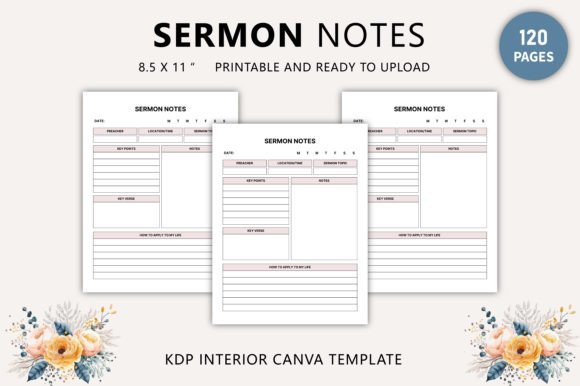
This isn’t about making notes look pretty—it’s about supporting attention, retention, and application. Each page includes guided sections: Scripture reference, main idea, key takeaways, personal response prompts, prayer space, and room for cross-references. That structure emerges from actual classroom and pulpit experience—not theoretical UX principles. Pastors using this template report fewer blank pages after services. Small group facilitators say participants arrive better prepared. And KDP publishers note higher repeat purchase rates because users treat these as functional tools—not disposable downloads.
The 8.5 x 11 inch size aligns with standard printing and binding options, while the 300 DPI CMYK PDF ensures crisp output whether printed at home, sent to a local print shop, or uploaded to Amazon KDP’s interior file requirements. No bleed means zero risk of critical text getting trimmed off during binding—a common pain point with self-published devotionals and study guides.
What You Actually Get (No Surprises)
You receive two core assets: a fully editable Canva link and a print-ready PDF. The Canva version gives you full control—swap colors, adjust spacing, add your church logo, insert custom scripture memory verses, or restructure the reflection prompts to match your curriculum. Every element is layered and labeled—not flattened or locked. You’re not editing a JPEG; you’re working with live text boxes, vector-style shapes, and grouped components built for iteration.
The PDF is pre-formatted for professional printing: 120 pages, CMYK color mode, 8.5 x 11 inches, no bleed, 300 DPI resolution. It’s ready for KDP interiors, saddle-stitched booklets, or spiral-bound handouts—no preflighting needed. And yes, you also get JPG and PNG exports for social media previews, email headers, or website banners. All files are 100% original—no stock clipart, no recycled layouts, no AI-generated filler graphics.
Design Flexibility Without Compromise
This template thrives in multiple contexts—not just Sunday morning. A blogger might use the Canva link to generate weekly reflection sheets for their email list. A Christian school teacher could adapt the layout for student Bible journaling assignments. A missions organization may localize the prompts for cross-cultural discipleship training—all without redesigning from scratch. Because the underlying grid system is responsive (in the print sense), resizing elements maintains proportion and readability.
Font choices were tested across devices and print outputs. Headings use a warm, humanist sans serif—friendly but authoritative. Body text is set in a slightly increased x-height sans with open counters, ensuring clarity even when handwritten notes overlap or ink bleeds slightly on lower-grade paper. There are no script or decorative fonts competing for attention. This is intentional: spiritual reflection benefits from calm typography—not visual distraction.
Practical Tips for Getting the Most Out of It
- Start with the PDF if you need immediate printouts. Open it in Acrobat or Preview, fill in sample notes, and test how your pen flows across the page. Does the spacing support your handwriting style? Adjust line height in Canva later if needed—but base changes on real usage, not assumptions.
- Use the Canva link for branding consistency. Upload your church’s primary font (if licensed for digital use) and apply it to headers. Swap accent colors to match your website palette. Save multiple versions: one for preaching teams, another for youth groups, a third for online courses.
- Test readability before bulk printing. Print one page double-sided on your target paper stock. Read it under typical lighting conditions—especially if distributing to older adults or in low-light settings like early-morning prayer meetings.
- Pair intentionally—not arbitrarily. If adding supplemental graphics (e.g., QR codes linking to sermon audio), keep them monochrome and place them outside the main note zone. Avoid overlapping with margin prompts or response lines. Visual hierarchy should always serve the content—not compete with it.
Commercial use is fully covered: you can sell printed copies, bundle them with sermon series, include them in paid discipleship programs, or offer them as lead magnets—no attribution required. The license grants full rights to modify, distribute, and monetize, which matters whether you're a solo pastor launching a Patreon or a publishing house scaling devotional products.
What makes the Sermon Notes Canva Template different isn’t just what’s included—it’s what’s been left out. No bloat. No forced trends. No assumptions about your theology, tradition, or tech access. Just a reliable, adaptable foundation for thoughtful engagement with Scripture. Whether you’re designing for print, digital distribution, or hybrid ministry models, this template respects your time, your audience’s attention, and the weight of the message itself.